Wednesday, January 4, 2006

Play at NSD Festival- THEATRE UTSAV


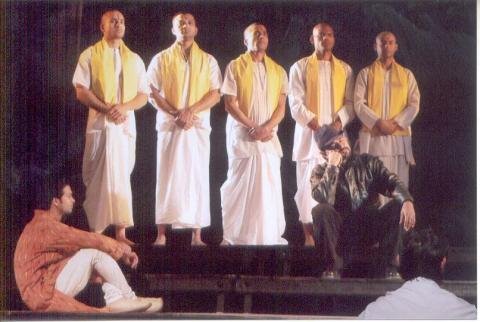
YAMA GATHA
10th January 2006,9.30pm
Abhimanch Auditorium,
N.S.D. Mandi House,New Delhi
Theatre Utsav
Bharat Rang Mahotsava-2006

PRODUCTION DETAILS
PLAY : YAMA GATHA
ASMITA ARTS GROUP, DELHI

THEATRIC SIGNIFICANCE OF THE PRODUCTION
( as conceived by the director)

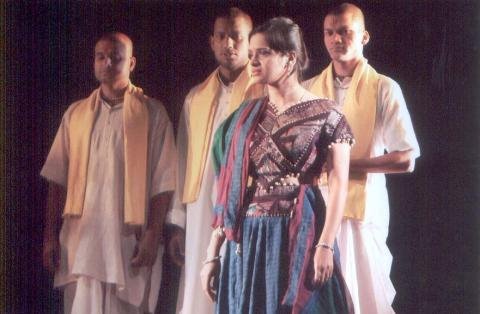
This play focuses on the brutality, cruelty and manipulations of the ‘ones in power’ which they exert in order to maintain their authority and domination. The main aim of the ‘system’ is to come in terms with the opposition, no matter if the opponents are sacrificed in the name of religion and under the shelter of law (!). The system leaves nothing unturned. False propaganda is frivolously used to demean the opposition.

Yama Gatha throws light on this naked truth. Though mythology forms the basis of the presentation but the content undoubtedly shows its parallel existence in contemporary world situation. The playwright Prof. Doodh Nath Singh has remarkably brought out the prevelant social and political power game situations through the medium of ‘Indra’ and ‘Pururva’. The play is a strong statement on the continuous ‘unannounced’ exploitation which third world countries suffer at hands of developed nations.

Deep rooted racial discrimination and caste hierarchies forming the basis of marginalisation, subjugation, subordination and inequality still relevant in Indian as well as global context also find wide representation in the play. Indra is the epitome of ‘World power’ and Brahmins, Rishikul and Raja are his tools in the game of power. Through these tools Indra exploits the people and gets his opponents killed by manipulative declaring them ‘agaisnt religion’ and ‘against mankind’. He calls them ‘Anarya’ and ‘Dasyu’, so as to isolate them from mainstream. ‘Yajna’ for him is an important medium of carrying forward this exploitation. Schools of serviles, parasites, music, alcohol and sex make an integral part of his ‘kootneeti’.

The play exposes the farcical, cruel and distorted face of reality of politics through Indra. On the other side Vasishtha and Pururva are striving to restore power to the people. They work together to bring light to the people; they fight for their rights and their welfare. Neither do people have enough fire to live nor do they have access to resources to survive. People are exploited by Brahmins and Purohits in the name of sacrifices and yajnas. Pururva wages war against this exploitation.

Indra fears Pururva and tries to tempt him and appropriate him and his guru Vasishtha into the system. Not succeeding in his plans he gets Pururva killed in Purushmedh Yajna under the cover of ‘Dharm Sammat Nyaya’.
Yama Gatha attacks the cruel and two faced system and politics in the name of religion. Through Urvashi and Ila, the two women characters, the question of feminine identity and Asmita comes up strikingly in this play.

The conflict between two ‘streams of thought’ or ‘cultures’; conflict between those striving for identity, recognition and survival and those engaged in politics of domination, provides strength and sets a large canvas for this play.

Yama Gatha initiates a debate and raises questions on issues related to politics of gender, race, cultural and social identity, knowledge and development. Though the storyline of this play is based on a ‘myth’ but anyone can easily identify the images of these issues in contemporary world politics.

__________________________________________
Director’s Note:
What is a myth? Far away from reality…..Is it?
A commentary on existence……An unstated, un revealed compass of contemporariness of ever changing undefined, redefined, unrefined realities. Realities and reality of conflicts, sometimes we chose to close our eyes upon or forget to take cognizance of. Post-Iraq the world is not same as before. The days and months have become a game of numbers in the playfield of violence. Recently the 29/10 is the new set of numbers which has got added to our encyclopedia of violence.
What lies beneath?

Getting up to the mirror also does not help look at the reality. Whose face is this? A reflected image; an image not real. Face this. Is it easy to look at the other? Myth may be the answer.
I chose to install the myth in the modern so as to make an attempt to raise questions on the contemporary reality.
As the playwrite Doodh Nath Singh points out,’ Agar Kalidas ke utkrushta romantic ghatatop se bahar aa jayein to Pururva-Urvashi ke mithak mein bahut kuch aisa hei jisey naya arth diya ja sakta hei’.

What seems so unreal, ahistorical in a myth comes alive through this treatment and hit senses to the contemporary worldscape of exploitation, bloodshed and other forms of violence, revealing reality. This myth thus unravels the reality of our being. A commentary on existence, a reading of the myth in contemporary times.

____________________________________

ON STAGE

(In Order of Appearance)

Suryabahu : Amit Rana
Krishnanag : Rohan Madhesia
Kashyap : Sandeep Srivastava
Vibhavak : Pushpraj Rawat
Vasishtha : Akhilesh Praveen
Ila : Sapna
Pururva : Ajit Kumar Mehto

Gan Pratinidhi : Rakesh Shah, Mohd. Shamim, Avdhesh Kumar, Amit Basoiya, Rahul Batra, Kartik Shah, Deepak Rajor, Nidhi Sharma, Arun Khatana, Nitin Garg, Shailendra Kumar, Vinay Kumar, Bhavna Verma, Rajesh Raj, Prabhakar Ranjan, Sanjay Chauhan, Abir Maurya, Sharad Verma, Vijay Choudhary, Aman Sharma, Tanmay

Indra : Susan Brar
Vajra : Vipin Arora
Vishwavasu : Prageet Pandit
Rishi (1) : Sunil Rawat
Rishi (2) : Abhishek Jain
Sanat Kumar : Siddharth Dubey
Urvashi : Amita Walia
Prahari (1) : Abhijeet Choudhary
Prahari (2) : Amit Basoiya
Sipahi : Rakesh Shah, Pushpraj Rawat, Sandeep Srivastava, Vijay Choudhary, Rajesh Sangwan, Mhd. Shamim, Arun Khatana, Rahul Batra, Kartik Shah, Deepak Rajor, Aman Sharma, Nitin Garg, Shailendra Kumar, Vinay Kumar, Rajesh Raj, Prabhakar Ranjan, Abir Maurya, Sharad Verma, Amit Basoiya, Avdhesh Kumar, Ratnesh Srivastava
Gramwasi (1) : Sandeep Srivastava
Gramwasi (2) : Manisha Gulati /Amit Rana
Narad : Girish Pal
Paanch Purohit : Avdhesh Kumar, Rakesh Shah, Amit Basoiya, Abhijeet Choudhary, Abhishek Jain
Anya Purohit : Sunil Rawat, Manmohan Tiwari
Mukhya Purohit : Anupam Pachauri
Kisan : Rajesh Sangwan
Raja Nabhag : Shailendra / Mohd. Shamim

OFF STAGE
Set Execution :Ajit Kumar Mehto, Siddharth Dubey, Amit Rana
Costume :Akhilesh Praveen, Susan Brar, Kranti Pratap Singh
Property :Girish Pal, Prageet Pandit
Production Incharge :Anupam Pachauri,Sandeep Srivastava
Music :Dr. Sangeeta Gaur
Playwright :Dhoodh Nath Singh

_________________________________________________
Scenewise Synopsis of Yama Gatha

Scene I

Pururva the democratically elected representative of the people does not want to be coronated with use of same Mantra’s used to coronate Indra, the god-king. There’s debate between Ila, Vasishtha and Pururva over maintaing the wealth of tradition and vehement rejection and opposition of exploitative traditions.
The Brahmin duo whom Pururva refused give alms in exchange of singing of manras polluted with violence of Indra, plan to make best out of situation by preparing a false description of the events held and falsely implicating Pururva into using abusive words for Rishikul and Indra. They leave for Indra’s court to earn rewards with their story. Pururva declares that he is people’s representative and promises to pay heed to what people have to say. Pururva pledges to bring light, the sacred fire, for his people from Indra’s Kingdom and leaves for Amravati.

Scene II
Indra in court is planning with his Army Chief, Vajra to tempt Pururva through Urvashi, and appropriate his teacher Vasishtha by reverting the decision of his boycott by Rishi Sabha. Vasishtha arrives and refuses Indra’s offer. He says that this boycott does not matter to him.

He asks Indra very uneasy questions about his politics and people being Indra sends him to custody. Pururva arrives and asks Indra to release Vasishtha. Indra agrees and orders Vajra to release Vasishtha. Indra sends for Urvashi to meet king Pururva. Meanwhile Indra offers Somrus to Pururva. Pururva rejects the offer. Urvashi arrives in Indra’s court.
Indra gets drunk and falls to the floor. Pururva expresses his feelings understanding plight of a woman caught in a situation like Urvashi.

Urvashi asks Pururva to accept her in marriage since he understands the plight of a woman. Pururva offers to take her hand. Urvashi accepts his offer and leaves Amravati with Pururva.

Scene III

Pururva has taken away Agni from Amravati.
He orders Vajra to catch Pururva.
Indra is shocked that Urvashi has left him. Urvashi has been his tool to tempt and overpower his opponents.
Indra sends off Vishwavasu, the gandhrva to bring Urvashi back to him. He asks Sanatkumar to be his messenger to Pururva.

Scene IV
Sanatkumar visits Pururva’s court. While he engages Pururva and Vasishtha in the web of his words, Urvashi and her child is kidnapped by Vishwavasu.

Pururva gets caught by Vajra and his soldiers.

Scene V

Indra attempts to make up with Pururva by offering him Urvashi once again. Pururva rejects his offer. Indra is furious since he realizes that Pururva has some larger aim than getting Urvashi.

Scene VI

Indra’s soldiers can not find Vasishtha. Indra orders killing of Pururva through PurushMedh Yajna by implicating him falsely in cases of killing of protectors of Sacred Fire (Agni), poisoning Indra and destroyer of Yajna. He also orders inclusion of Vasishtha’s mantras in Rigved so as that Vasishtha can not contest him openly and also looses people’s support.As Urvashi arrives at the site of Purushmedha Yajna, Vishwavasu reveals to her that her son is alive. Vajra kills Vishwavasu.

Urvashi is forced to stamp the death sentence of Pururva.

The Purushmedha Yajna gets performed admist heartrending cries of Urvashi and singing of Mantras by Rishis, Brahmins and Indra’s courtiers.

_____________________________________


ABOUT THE GROUP

ASMITA, one of the leading Hindi theatre groups in the country, stands committed to aesthetically innovative and socially relevant theatre. Since its inception in 1993, ASMITA has carved a niche for itself in the Indian theatre scene by staging plays of varied socio-political interest while not losing out mass appeal. The group takes up contemporary issues to underline the contours of our time while providing the best of entertainment.

The group has 48 productions to its credit and on an average has been performing for about 60 nights a year. All these plays have been directed by ASMITA's Resident Director Arvind Gaur. For ASMITA, theatre has a purpose of awakening the audience to contemporary issue and creating a dialogue on prevailing social problems. ASMITA performed in all major theatre festivals of India including National School of Drama, (Bharat Rang Mahotsava),Sangeet Natak Akademi, SKP,Nandikar and Vivachana Theatre Festival, Old World Theatre Festival, Muktibodh Natya Samaroh,World Social Forum and Nehru Centre Festival Mumbai

In the past 12 years, the group has performed Girish Karnad's 'Tuglaq' and 'Rakt Kalyan', Dharamveer Bharti's 'Andha Yug', Swadesh Deepak's 'Court Martial', G P Deshpande's 'Antim Divas', Albert Camus' 'Caligula', Mahesh Dattani's 'Final Solutions' and 'Tara', Eugene O'neill 's 'Desire Under the Elms', Dario Fo's 'An Accidental Death of an Anarchist', Dr.Narenda Mohan's 'Kalandar', Bertolt Brecht's 'Good Woman of Setzuan' and 'Caucasian Chalk Circle', Samuel Beckett's 'Waiting For Godot', John Octanasek's 'Romeo Juliet and the Darkness', Neil Simon's 'The Good Doctor', Vijay Tendulkar's 'Ghasiram Kotwal', Munshi Premchand's 'Moteram ka Satyagrah', Ashok Lal's 'Ek Mamooli Aadmi', Rajesh Kumar's 'Me Gandhi Bolto', Vijay Mishra's 'Tatt Niranjana', Doodnath Singh's 'Yama Gatha', Uday Prakash's 'Warren Hastings ka Saand',
Bhishma Sahani's 'Madhavi' & Manjula Padmanbhan's 'Hidden Fires'(both solo by actress Rashi Bunny), Walking Through the Rainbow ( joint production with PCVC, solo by Rashi Bunny) & Gandhari ( solo by Aishveryaa Nidhi).

__________________________________________


ABOUT THE DIRECTOR

Arvind Gaur who heads the Delhi, based Theatre group ASMITA is committed to innovative and socially relevant theatre. Starting off as a journalist and working for sometime for the electronic media, he set up ASMITA and earned a reputation in theatre circle in India and abroad.

Arvind Gaur has conducted many theatre workshops and performed in various Colleges, Institutions, Universities and Schools in India and abroad such as Stanford, Harvard Uni , Stony Brook Uni, Smithsonian (Washington DC),Nehru Centre( London) ,Jawahar Lal Nehru University, IILM , I.I.T.(Delhi) , AIMS , School of Planning and Arhitecture.
One of his production "Madhavi", solo by Rashi Bunny was recently invited at International Theatre Festival , Russia,oct.2005

Workshops for children in schools and slums as well as Street Theatre performances on different socio-political issues organized and conducted by Arvind Gaur are many in number
He has also conducted theatre workshops for Actors and Directors at Houston, USA and India Habitat Centre, New Delhi. He also performed various plays in collobration with organizations like Theatre World, British Council(Chennai), IHC, Paridhi, Bahroop,Banjara Theatre group (IIT,Khargpur),IIC, Rainbow Cavaliers, M.Dot Band (Jaipur),Vivchana (Jabalpur), Prithvi Theatre Festival(platform theatre IHC,2004) and NGOs like Mobile Creches, Action-Aid,Haq,PCVC, Deepalaya , Heinrich Boll Foundation,Asian Social Forum, Youthreach and World Social Forum.

He also designs lights for NAYA theatre under the Direction of Shri Habib Tanvir.

Director Arvind Gaur has also collaborated with various Theatre artists and Groups specially in exploring a new language for Solo performances which includes Dario fo's 'Story of the Tiger', solo by Jaimini Kumar Srivastava, 'Women in Black' by Bubbles Sabharwal and "Untitled Solo" by Lushin Dubey in collaboration with Theatre World. Not only have these plays received great audience response from important metropolis of India, "Women in black" was invited to perform in Dubai and "Untitled Solo" was performed in Chicago, Dallas, Washington DC, Boston, Rochester , San francisco, Ohio in USA and at the Edinburgh Theatre Festival last year .
"Bitter Chocolate " a new solo by Lushin was also performed at Harvard (USA) & at Nehru Centre, London and Gandhari solo by Aishveryaa Nidhi was recently performed at NIDA theatre , Sydney.

With Rashi Bunny, young actress trained in Theatre design at University of Alabama at Birmingham and Rutgers University, New Jersey, USA. Arvind Gaur Has directed three solo's .Bhishma sahani's" Madhavi ", Manjula Padmanabhan's 'Hidden Fires'and 'Walking through the Rainbow'.
Madhavi & Hidden fires has received rave reviews all over and have been invited to perform for Mahindra's OLD WORLD THEATRE FESTIVAL, Vivachana National Theatre Festival Jabalpur, Muktibodh Natyaotsav raipur, 5th National Theatre Festival Balaghat, World Social forum Mumbai and National School Of Drama (N.S.D.), Satta Festival Jaipur, Theatre Club J.N.U., PCVC, and Queen's Award Project (UK) for Communal Harmony.
Bishma Sahani's MADHAVI, Solo by Rashi Bunny and directed by Arvind Gaur, received special award for best play in experimentaion with tradition at International Solo Theatre Festival , Armenia.

contacts- 98996-50-50-9
9810-606-823

http://www.theatredirector.blog.com/

Thursday, December 22, 2005

'4.48PSYCHOSIS ' SOLO PLAY BY BRITISH ACTRESS RUTH SHEARD DIRCTED BY ARVIND GAUR , IHC, 27TH DEC


Asmita Art Group presents-

4.48 PSYCHOSIS
Solo performance by
British actress Ruth Sheard
27 th December at IHC at 7.30 pm
A Play by Sarah Kane
Directed by Arvind Gaur

"And my mind is the subject of these bewildered fragments".
4.48 Psychosis, the controversial playwright Sarah Kane's last play is a report from a region of the mind that most of us hope never to visit but from which many people cannot escape. Written whilst she herself was suffering from clinical depression, the play is as compact and beautiful as a diamond structure √ yet the mood it inspires is as black as coal.
Kane herself committed suicide shortly after finishing the play, yet surprisingly, the work is a celebration of the human impulse to create art through adversity.

Sarah Kane
(February 3, 1971- February 20, 1999) was a British playwright. Her plays dealt uncompromisingly with themes of death, sex, violence and mental illness, and are characterised by an increasing poetic intensity, a rich affirmation of love in all its forms, and by use of sharply violent imagery so powerful that it cuts across and fragments the narrative, perhaps an attempt to give us the experience of a life torn up by its roots.She struggled with intense manic depression for many years, but continued to work, and was for some time the writer-in-residence at the Royal Court theatre.

About the Actor
Ruth Sheard ,eminent British actress, gained her BA Hons Degree in Contemporary Theatre and Dance and has worked extensively in experimental theatre and contemporary art. Ruth has toured Germany with several shows including Aykbornes 'Relatively Speaking' .
Ruth is now on a theatre world tour working on several different projects.

Critics Say

The beauty and rawness-the combination of unprocessed honesty and meticulous craft- remains as striking as ever; Kane's power to take material beyond endurance and shape it, burnish it, laugh at it, dominate with her art.
-Scotsman

As compact and beautiful as a diamond in structure and yet the mood it inspires is as black as coal.
-Time Out

'Sarah Kane 'wrote simply and starkly about the world she saw around her-a mature and vividly thatrical response to the pain of living.
-The Guardian

Kane was a dramatist original enough to communicate ultimate emotions with a strange beauty as well as with a frightening bluntness.
-The Times

4.48 Psychosis is a report from a region of the mind that most of us hope never to visit but from which many people cannot escape. Those trapped there are normally rendered voiceless by their condition.
-David Greig

About the Director

Arvind Gaur who heads the Delhi, based Theatre group ASMITA is committed to innovative and socially relevant theatre. Starting off as a journalist and working for sometime for the electronic media, he set up ASMITA and earned a reputation in theatre circle in India and abroad.
Arvind Gaur has conducted many theatre workshops and performed in various Colleges, Institutions, Universities and Schools in India and abroad such as Stanford, Harvard Uni , Stony Brook Uni, Smithsonian (Washington DC),Nehru Centr (London) ,Jawahar Lal Nehru University, IILM , I.I.T.(Delhi) , AIMS , School of Planning and Arhitecture.
One of his production "Madhavi", solo by Rashi Bunny was recently invited at International Theatre Festival , Russia,oct.2005
Workshops for children in schools and slums as well as Street Theatre performances on different socio-political issues organized and conducted by Arvind Gaur are many in numberHe has also conducted theatre workshops for Actors and Directors at Houston, USA and India Habitat Centre, New Delhi. He also performed various plays in collobration with organizations like Theatre World, British Council(Chennai), IHC, Paridhi, Bahroop,Banjara Theatre group (IIT,Khargpur), IIC, Rainbow Cavaliers, M.Dot Band (Jaipur),Vivchana (Jabalpur),Darpan Academy, Prithvi Theatre Festival(platform theatre IHC,2004),and NGOs like Mobile Creches,Action-Aid, Haq, PCVC, Deepalaya , Heinrich Boll Foundation, ASF,Youthreach and World Social Forum.
He also designs lights for NAYA theatre under the Direction of Shri Habib Tanvir.
Director Arvind Gaur has also collaborated with various Theatre artists and Groups specially in exploring a new language for Solo performances which includes Dario fo's 'Story of the Tiger', solo by Jaimini Kumar Srivastava, 'Women in Black' by Bubbles Sabharwal and "Untitled Solo" by Lushin Dubey in collaboration with Theatre World. Not only have these plays received great audience response from important metropolis of India, "Women in black" was invited to perform in Dubai and "Untitled Solo" was performed in Chicago, Dallas, Washington DC, Boston, Rochester , San francisco, Ohio in USA and at the Edinburgh Theatre Festival last year .
"Bitter Chocolate " a new solo by Lushin was also performed at Harvard (USA) & at Nehru Centre, London and Gandhari solo by Aishveryaa Nidhi was recently performed at NIDA theatre , Sydney.
With Rashi Bunny, young actress trained in Theatre design at University of Alabama at Birmingham and Rutgers University, New Jersey, USA. Arvind Gaur Has directed three solo's .Bhishma sahani's" Madhavi ", Manjula Padmanabhan's 'Hidden Fires'and 'Walking through the Rainbow'.
Madhavi & Hidden fires has received rave reviews all over and have been invited to perform for Mahindra's OLD WORLD THEATRE FESTIVAL, Vivachana National Theatre Festival Jabalpur, Muktibodh Natyaotsav raipur, 5th National Theatre Festival Balaghat, World Social forum Mumbai and National School Of Drama (N.S.D.), Satta Festival Jaipur, Theatre Club J.N.U., PCVC, and Queen's Award Project (UK) for Communal Harmony.
Bishma Sahani's MADHAVI, Solo by Rashi Bunny and directed by Arvind Gaur, received special award for best play in experimentaion with tradition at International Solo Theatre Festival, Armenia.

ABOUT THE GROUP

ASMITA, one of the leading Hindi theatre groups in the country, stands committed to aesthetically innovative and socially relevant theatre. Since its inception in 1993, ASMITA has carved a niche for itself in the Indian theatre scene by staging plays of varied socio-political interest while not losing out mass appeal. The group takes up contemporary issues to underline the contours of our time while providing the best of entertainment.
The group has 48 productions to its credit and on an average has been performing for about 60 nights a year. All these plays have been directed by ASMITA's Resident Director Arvind Gaur. For ASMITA, theatre has a purpose of awakening the audience to contemporary issue and creating a dialogue on prevailing social problems. ASMITA performed in all major theatre festivals of India including National School of Drama, (Bharat Rang Mahotsava),Sangeet Natak Akademi, SKP,Nandikar and Vivachana Theatre Festival, Old World Theatre Festival, Muktibodh Natya Samaroh,World Social Forum and Nehru Centre Festival Mumbai

In the past 12 years, the group has performed Girish Karnad's 'Tuglaq' and 'Rakt Kalyan', Dharamveer Bharti's 'Andha Yug', Swadesh Deepak's 'Court Martial', G P Deshpande's 'Antim Divas', Albert Camus' 'Caligula', Mahesh Dattani's 'Final Solutions' and 'Tara', Eugene O'neill 's 'Desire Under the Elms', Dario Fo's 'An Accidental Death of an Anarchist', Dr.Narenda Mohan's 'Kalandar', Bertolt Brecht's 'Good Woman of Setzuan' and 'Caucasian Chalk Circle', Samuel Beckett's 'Waiting For Godot', John Octanasek's 'Romeo Juliet and the Darkness', Neil Simon's 'The Good Doctor', Vijay Tendulkar's 'Ghasiram Kotwal', Munshi Premchand's 'Moteram ka Satyagrah', Ashok Lal's 'Ek Mamooli Aadmi', Rajesh Kumar's 'Me Gandhi Bolto', Vijay Mishra's 'Tatt Niranjana', Doodnath Singh's 'Yama Gatha', Uday Prakash's 'Warren Hastings ka Saand',
Bhishma Sahani's 'Madhavi' & Manjula Padmanbhan's 'Hidden Fires'(both solo by actress Rashi Bunny), Walking Through the Rainbow ( joint production with PCVC, solo by Rashi Bunny) & Gandhari ( solo by Aishveryaa Nidhi).


Contact-
arvindgaur@hotmail.com,
arvindasmita@yahoo.com
09899650509,
09810606823

Tuesday, December 6, 2005

COURTMARTIAL AT OXFORD BOOK STORE

Dialogue

O X F O R D
BOOK STORE

An Oxford Bookstore Theatre Initiative
& Asmita art Group

Invite you to
A Gripping erformance of

SWADESH DEEPAK’S

COURT-MARTIAL

Direction - Arvind Gaur


8th December , 5.45 pm
OXFORD BOOK STORE
Statesman House, First Floor,
148, barakhamba Road, N. Delhi -110001

ABOUT THE PLAY

When respect is denied to a man for the only reason that he is borne by ‘low-caste’ parents, the offence cannot simply be termed as a social violence. It assumes larger proportions of crime against humanity and society at large.
Yet by the turn in situation the murderer becomes a winner whereas the victim is unforgiven. The culprit may receive severe punishment at the hands of the law but, in fact, it is the society which is put in the docks.
Court Martial,written by Swadesh Deepak, is a story of recruit Ram Chander who is tried for murdering one of his officers and injuring another. The Court Martial is presided by a war veteran.Col. Surat Singh who has witnessed many ‘life –and –death’ situation. But this trial puts him in a queer position, so far unknown to him, and during the course of interrogation he realize that the issues at stake are much larger than what meets the eye. Realizing that the Indian Army is the only government agency in which reservation on caste basis is not permissible. Court Martial presents a combination of legal and poetic justice.

CRITICS SAY

Tight pace of Court Martial….not to be missed .
- Kavita Nagpal (H.T.)
Gaur’s hard hitting realism…..His infinitely intelligent approach….strong play.
- Aruna Ahluwalia (E.News)
Kudos to Court Martial….a drama that went beyond the limits of drama .
- (Indian Express)
The Asmita team has created a marvelous piece of theatre out of a wonderful script….don’t miss it. The times spent watching it is well worth it.
-Smita Narula (Pioneer)
Stealing scenes with revolt as the theme ….Court Martial was an engrossing display of theatre for social awareness.
-Sushama Chadha (T.O.I.)
Excellent acting, live and memorable…..worth visit.
-Ajit Rai (N.B.T.)

ABOUT THE GROUP

ASMITA, one of the leading Hindi theatre groups in the country, stands committed to aesthetically innovative and socially relevant theatre. Since its inception in 1993, ASMITA has carved a niche for itself in the Indian theatre scene by staging plays of varied socio-political interest while not losing out mass appeal. The group takes up contemporary issues to underline the contours of our time while providing the best of entertainment.

The group has 48 productions to its credit and on an average has been performing for about 60 nights a year. All these plays have been directed by ASMITA's Resident Director Arvind Gaur. For ASMITA, theatre has a purpose of awakening the audience to contemporary issue and creating a dialogue on prevailing social problems. ASMITA performed in all major theatre festivals of India including National School of Drama, (Bharat Rang Mahotsava),Sangeet Natak Akademi, SKP,Nandikar and Vivachana Theatre Festival, Old World Theatre Festival, Muktibodh Natya Samaroh,World Social Forum and Nehru Centre Festival Mumbai

In the past 12 years, the group has performed Girish Karnad's 'Tuglaq' and 'Rakt Kalyan', Dharamveer Bharti's 'Andha Yug', Swadesh Deepak's 'Court Martial', G P Deshpande's 'Antim Divas', Albert Camus' 'Caligula', Mahesh Dattani's 'Final Solutions' and 'Tara', Eugene O'neill 's 'Desire Under the Elms', Dario Fo's 'An Accidental Death of an Anarchist', Dr.Narenda Mohan's 'Kalandar', Bertolt Brecht's 'Good Woman of Setzuan' and 'Caucasian Chalk Circle', Samuel Beckett's 'Waiting For Godot', John Octanasek's 'Romeo Juliet and the Darkness', Neil Simon's 'The Good Doctor', Vijay Tendulkar's 'Ghasiram Kotwal', Munshi Premchand's 'Moteram ka Satyagrah', Ashok Lal's 'Ek Mamooli Aadmi', Rajesh Kumar's 'Me Gandhi Bolto', Vijay Mishra's 'Tatt Niranjana', Doodnath Singh's 'Yama Gatha', Uday Prakash's 'Warren Hastings ka Saand',
Bhishma Sahani's 'Madhavi' & Manjula Padmanbhan's 'Hidden Fires'(both solo by actress Rashi Bunny), Walking Through the Rainbow ( joint production with PCVC, solo by Rashi Bunny) & Gandhari ( solo by Aishveryaa Nidhi).

CAST(In order of appearance)

Col. Surat Singh : Susan Brar
Judge consultant- I : Sandeep Srivastava
Judge consultant­-II : Amita Walia
Judge-III: Shamim Gandhi / Rajesh Mishra
IV: -Sunil rawat
V: Rajesh Kumar / Awadesh Kr.
Major Ajay Puri : Ajeet Kumar Mahato
Capatian Bikash Rai : Pushpraj Rawat
Subedar Balwan Singh : Prageet Pandit
Cap. Dr. Gupta : Vipin Arora
Lt. Col. Breajendra Rawat : Amit Rana
Captian BD. Kapoor : Akhilesh Praveen
Ramchander : Rohan Madeshya
Soldier -I : Shilendra Bist
Soldier –II : Rakesh Shah

ENACTMENTS
Ramchadar : Sidharth Dubey
Capatian Kapoor : Siddarth Dubey
Mrs. Kapoor : Anupam Pachauri/Nidhi sharma
Soldiers : Sanjay Chawhan, Kartik Shah, Abhijit, Suleman Khan, Aman Sharma,
Deepak Rajor,Abeer Mourya, Amit Baisoya, Sharad Verma, Prabhakar Ranjan,
Abhishek Sharma, Rajesh raj, Nitin Garg,Ashutosh Das,

Music : Dr. Sangeeta Gaur

PRODUCTION
Sunil Rawat,Sharad Verma,Akhilesh Praveen,Ajit Mahto,Susan Brar,Kranti Pratap Singh,Sandeep Srivastava, Girish Pal,Ruth Sheard

ABOUT THE DIRECTOR

Arvind Gaur who heads the Delhi, based Theatre group ASMITA is committed to innovative and socially relevant theatre. Starting off as a journalist and working for sometime for the electronic media, he set up ASMITA and earned a reputation in theatre circle in India and abroad.
Arvind Gaur has conducted many theatre workshops and performed in various Colleges, Institutions, Universities and Schools in India and abroad such as Stanford, Harvard Uni , Stony Brook Uni, Smithsonian (Washington DC),Nehru Centr (London) ,Jawahar Lal Nehru University, IILM , I.I.T.(Delhi) , AIMS , School of Planning and Arhitecture.One of his production "Madhavi", solo by Rashi Bunny was recently invited at International Theatre Festival , Russia,oct.2005
Workshops for children in schools and slums as well as Street Theatre performances on different socio-political issues organized and conducted by Arvind Gaur are many in numberHe has also conducted theatre workshops for Actors and Directors at Houston, USA and India Habitat Centre, New Delhi. He also performed various plays in collobration with organizations like Theatre World, British Council(Chennai), IHC, Paridhi, Bahroop,Banjara Theatre group (IIT,Khargpur), IIC, Rainbow Cavaliers, M.Dot Band (Jaipur),Vivchana (Jabalpur), Prithvi Theatre Festival(platform theatre IHC,2004) and NGOs like Mobile Creches, Darpan Academy, Action-Aid, Haq, PCVC, Deepalaya , Heinrich Boll Foundation, ASF,Youthreach and World Social Forum.
He also designs lights for NAYA theatre under the Direction of Shri Habib Tanvir.
Director Arvind Gaur has also collaborated with various Theatre artists and Groups specially in exploring a new language for Solo performances which includes Dario fo's 'Story of the Tiger', solo by Jaimini Kumar Srivastava, 'Women in Black' by Bubbles Sabharwal and "Untitled Solo" by Lushin Dubey in collaboration with Theatre World. Not only have these plays received great audience response from important metropolis of India, "Women in black" was invited to perform in Dubai and "Untitled Solo" was performed in Chicago, Dallas, Washington DC, Boston, Rochester , San francisco, Ohio in USA and at the Edinburgh Theatre Festival last year .
"Bitter Chocolate " a new solo by Lushin was also performed at Harvard (USA) & at Nehru Centre, London and Gandhari solo by Aishveryaa Nidhi was recently performed at NIDA theatre , Sydney.
With Rashi Bunny, young actress trained in Theatre design at University of Alabama at Birmingham and Rutgers University, New Jersey, USA. Arvind Gaur Has directed three solo's .Bhishma sahani's" Madhavi ", Manjula Padmanabhan's 'Hidden Fires'and 'Walking through the Rainbow'.
Madhavi & Hidden fires has received rave reviews all over and have been invited to perform for Mahindra's OLD WORLD THEATRE FESTIVAL, Vivachana National Theatre Festival Jabalpur, Muktibodh Natyaotsav raipur, 5th National Theatre Festival Balaghat, World Social forum Mumbai and National School Of Drama (N.S.D.), Satta Festival Jaipur, Theatre Club J.N.U., PCVC, and Queen's Award Project (UK) for Communal Harmony.
Bishma Sahani's MADHAVI, Solo by Rashi Bunny and directed by Arvind Gaur, received special award for best play in experimentaion with tradition at International Solo Theatre Festival, Armenia.

Contact-arvindgaur@hotmail.com,
arvindasmita@yahoo.com
09899650509

Saturday, December 3, 2005

MADHAVI SOLO BY RASHI BUNNY :THE STORY OF EVERY WOMAN,HT CITY


MADHAVI SOLO BY RASHI BUNNY :THE STORY OF EVERY WOMAN
by Mita Kapur
Hindustan Times
20th nov.2005

One woman. Like the Earth, she bears, she nurtures, she cares. She must give up her sense of self, her feelings, her desires to fulfil her ‘duty’ towards the ‘man’. The ‘man’ sometimes is her father, her lover, her husband, her brother, her son – it is an eternal journey of sacrifice. This one woman, you may call her Madhvi, Mandakini, or Monica, she has passed through 5000 years of history, merely existing for the ‘man’.
The play, ‘Madhvi’, solo by Rashi Bunny staged at JKK last evening, brought to town by the IILM Academy of Higher Learning, is the story of every woman. Dimensions of Time and Space cease to matter. Canvas and colours of our culture - mehndi, gulaal, haldi, roli, sand are used by the protagonist to paint the _expression of her feelings as she goes through the play. The woman is a symbol of creation. And yet she must suffer.
Madhvi, the beautiful daughter of Yayati is given away to a devoted disciple of Guru Vishwamitra, Galav. Why ? Galav must fulfil his duty towards his guru. He must procure 800 Ashwamedha horses as gurudakshina. An indomitable task. The woman must step in to rescue the man from his predicament. First, the man who is her father, who has to prove to the world he is a ‘mahadaanveer’. So the daughter must be sacrificed. The dutiful disciple, Galav, must abide by his word, given to his guru.
Madhvi, bestowed with the power of recurring youth and the ‘vardaan’ that she will give birth only to sons, is used by Galav as a mere instrument. Both men endeavour to achieve fame through the resilience and forbearance of a woman.
She is auctioned off to one king after another, to bear each a son in exchange for 200 horses. The raj jyotish examines her body, from her soft fingers and toes to her shining forehead and pronounces her destined to bear only ‘chakravarti’ sons. She wins the love and respect of the kings – after all she will bear the heir apparent to their thrones.
A woman exchanged for horses. Because she must respect the wishes of her father. For she loves Galav, pines for him to be free from his responsibility, dreams of a life with him. She feels for her child, Vasomana. But she must abandon the emotional shackles of motherhood for she is on a mission for the man she has vowed herself to.
A flood that drowns all the horses and Vishwamitra buys the surviving Ashwamedhas. Galav despairs and Madhvi rises once again to meet the blows of life. The woman self-auctions herself to Vishwamitra for the last 200 horses. The last son is born. There is a resonance of gaiety, celebration. The great Yayati will finally give away his Madhvi in a swayamvara.
Madhvi yearns for her life with Galav. She dreams to be free. She has gone through the courts of three kings and the guru himself just for the love of her man. Galav finds her in her real state, wrinkled, tired, middle – aged. He will not accept her without her youth. She feels she is free to be herself at least with the man she has lived her life for. But Galav, is just another ‘man’. He must escape ugly reality. “You have lived with my guru, how can I take you back in my life ?”
Life has come a full circle. Madhvi, the woman, the individual is lost forever. She is alone, she must bear the brunt of living only for others, never for herself. She dawns white, signifying yet another lonesome journey.
A solo performance by Rashi Bunny, directed by Arvind Gaur, based on a Bhishma Sahni’s script was a gripping portrayal of reality. Madhvi is reality. A powerful rendition of 16 roles by Rashi, evoked mesmerised silence and resounding applause from the audience. Recalling her earlier performance in Balaghat (MP), Rashi said, “a lady walked up to me and asked me, ‘can I touch you ?’ after watching the play. I felt so small. I am on a mission, a spiritual journey, I’m not acting.”
Working in two more solo performances, ‘Hidden Fires’ by Manjula Padmanabhan and ‘Walking through the Rainbow’, for Rashi the woman, Rashi the actress, all boundaries fade as she immerses herself completely, unabashedly in her roles.
The play was among the very rare meaningful theatre we get to watch in our city. Thought provoking, overwhelming, it left so many fighting their tears. Each person present would have identified with the double standards of our society, each person sitting there would have felt guilty of having reduced the existence of a woman to a mere object, a commodity. Each woman would have relived some part of her life.


Mita Kapur
Hindustan Times,Jaipur

Friday, September 30, 2005

THE WAR WITHIN - MUMBAI MIRROR / DEEPA GAHLOT

A Hindi production of Mahesh Dattani's Final Solutions comes to Mumbai

Deepa Gahlot

Final Solutions is one of Mahesh Dattani's best known plays, it has had several productions (including one at Bangalore's Rang Shankara earlier this year), and won the playwright Mahesh Dattani a Sahitya Akademi Award.

His fifth play was eerily prescient, since it was written in 1991 before the Mumbai communal riots. The first production of the play to be directed by Dattani himself in Bangalore, was cancelled due to its volatile content. A little later, when the riots had given it a frightening relevance, Alyque Padamsee did a critically acclaimed production in Mumbai.

The play is about a Hindu family sheltering two Muslim boys during a riot, during the course of which deep seated prejudices are uncovered.

Mumbai will see a Hindi version of the play (Shahid Anwar adapted it), directed by Arvind Gaur, at the ongoing National Theatre Festival at Nehru Centre.

Arvind Gaur who heads the Delhi-based theatre group Asmita has done over 48 plays in the 12 years since he set up the group, and most of them have been socially relevant; Girish Karnad's Tuglaq, Dharamveer Bharti's Andha Yug, Dario Fo's An Accidental Death of an Anarchist, Munshi Premchand's Moteram Ka Satyagrah, Ashok Lal's Ek Mamooli Aadmi, Pinki Virani's Bitter Chocolate, Bhishma Sahani's Madhavi, Manjula Padmanbhan' Hidden Fires to name a few.

His latest production, Mr Jinnah was banned in Delhi leading to widespread protests by the theatre community. Final Solutions is still as powerful as when it was first performed-though it has been criticized for being a one-sided portrayal of communalism. The play examines the problem of communalism from the days of Partition to the present, through the eyes of three generations of a Gujarati Hindu family.

Hardika, the grandmother, cannot forget the Partition trauma, the betrayal by a Muslim friend and her father's murder. Her son lives with the guilt that his fortunes were founded on the ashes of a Muslim establishment burnt down by a Hindu mob. Hardika's daughter-in-law is a strict Hindu and the granddaughter cannot think of a relationship with a Muslim boy. The inner turmoil is exposed when two Muslim boys, Babban and Javed, being chased by Hindu rioters seek refuge in their house.

While a verbal and spiritual tug of war goes on, a Chorus comments on the conflicts faced by the characters-a device that helps put the various issues into perspective in the intense and disturbing play.

Gaur says in his Director's Note: " Final Solutions touches us, and the bitter realities of our lives so closely that it becomes a difficult play to handle for the Indian director. The past begins top determine the outlook of the present and thus the earlier contradictions reemerge. No concrete solutions are provided in the play to the problem of communalism but it raises questions on secularism and pseudo secularism. It forces us to look at ourselves in relation to the attitudes that persist in the society. Since it is an experiment in time and space and relates to memory, it is a play, which involves a lot of introspection on the part of the characters in the play and thus induces similar introspection in the viewers."

Wednesday, September 28, 2005

SWADESH DEEPAK'S PLAY COURTMARTIAL ,1st OCT 2005

________________________
SWADESH DEEPAK’S

COURT-MARTIAL
________________________


Direction - Arvind Gaur


1st oct 2005 at 7.30 p.m.,

Gandhi Smriti ,30 January Marg,New Delhi

TIMES FOUNDATION


ABOUT THE PLAY
_______________

When respect is denied to a man for the only reason that he is borne by ‘low-caste’ parents, the offence cannot simply be termed as a social violence. It assumes larger proportions of crime against humanity and society at large.

Yet by the turn in situation the murderer becomes a winner whereas the victim is unforgiven. The culprit may receive severe punishment at the hands of the law but, in fact, it is the society which is put in the docks.

Court Martial,written by Swadesh Deepak, is a story of recruit Ram Chander who is tried for murdering one of his officers and injuring another. The Court Martial is presided by a war veteran.

Col. Surat Singh who has witnessed many ‘life –and –death’ situation. But this trial puts him in a queer position, so far unknown to him, and during the course of interrogation he realize that the issues at stake are much larger than what meets the eye. Realizing that the Indian Army is the only government agency in which reservation on caste basis is not permissible. Court Martial presents a combination of legal and poetic justice.


CRITICS SAY
_______________

Tight pace of Court Martial….not to be missed .

- Kavita Nagpal (H.T.)


Gaur’s hard hitting realism…..His infinitely intelligent approach….strong play.

- Aruna Ahluwalia (E.News)

Kudos to Court Martial….a drama that went beyond the limits of drama .

- (Indian Express)
The Asmita team has created a marvelous piece of theatre out of a wonderful script….don’t miss it. The times spent watching it is well worth it.

-Smita Narula (Pioneer)

Stealing scenes with revolt as the theme ….Court Martial was an engrossing display of theatre for social awareness.

-Sushama Chadha (T.O.I.)

Excellent acting, live and memorable…..worth visit.

-Ajit Rai (N.B.T.)


ABOUT THE GROUP
___________________

ASMITA (A Sedulous Move for Innovative Theatre Activities) stands committed to aesthetically innovative and socially relevant theatre. It takes up contemporary issues to underline the contours of our time while providing the best of entertainment. It is today one of the leading hindi theatre groups in the country.
To date, it has 48 production to its credit and on an average has been performing for about 60 nights a year.
All these plays have been directed by Asmita’s Resident, Director Arvind Gaur. For ASMITA, theatre has a purpose of awakening the audience to contemporary issue and creating a dialogue on prevailing social problems.
It has carved a niche for itself in the Indian theatre scene by staging plays of varied socio-political interest while not losing out mass appeal.


CAST
______


(In order of appearance)

Col. Surat Singh : Susan Brar
Judge consultant- I : Sandeep Srivastava

Judge consultant­-II : Amita Walia
Judge-III: Shamim Gandhi / Rajesh Mishra

IV: Sunil rawat / Mohit Chabbra
V: Rajesh Kumar / Awadesh Kr.

Major Ajay Puri : Ajeet Kumar Mahato
Capatian Bikash Rai : Pushpraj Rawat

Subedar Balwan Singh : Prageet Pandit

Cap. Dr. Gupta : Vipin Arora

Lt. Col. Breajendra Rawat : Amit Rana
Captian BD. Kapoor : Akhilesh Praveen
Ramchander : Rohan Madeshya

Soldier -I : Shilendra Bist
Soldier –II : Rakesh Shah


ENACTMENTS___________


Ramchadar : Sidharth Dubey
Capatian Kapoor : Tanmay /Siddarth Dubey
Mrs. Kapoor : Anupam Pachauri

Soldiers : Sanjay Chawhan, Kartik Shah, Abhijit, Suleman Khan, Aman Sharma,

Deepak Rajor,Abeer Mourya, Amit Baisoya, Sharad Verma, Prabhakar Ranjan,

Abhishek Sharma, Rajesh raj, Nitin Garg,Ashutosh Das

Music : Dr. Sangeeta Gaur

PRODUCTION
____________

Sunil Rawat,Sharad Verma,Akhilesh Praveen,Ajit Mahto,Susan Brar,Kranti Pratap Singh,Sandeep Srivastava


ABOUT THE DIRECTOR
______________________

Arvind Gaur who heads the Delhi , based Theatre group ASMITA is committed to innovative and socially relevant theatre. Starting off as a journalist and working for sometime for the electronic media, he set up ASMITA and earned a reputation in theatre circle in India and abroad.

In the past 12 years, he has directed 48 major plays which include Girish Karnad's Tuglaq and Rakt Kalyan, Dharamveer Bharti's Andha Yug, Swadesh deepak's Court
Martial, G P Deshpande's Antim Divas, Albert Camus' Caligula, Mahesh Dattani's Final Solutions and Tara, Eugene O'neill 's Desire Under the Elms, Dario Fo's An
Accidental death of an Anarchist, Dr.Narenda Mohan's Kalandar, Bertolt Brecht's Good Woman of Setzuan and Caucasian chalk circle, Samuel Beckett's Waiting For Godot, John Octanasek's Romeo Juliet and the darkness, Neil Simon's The Good
Doctor, Vijay tendulakr's Ghairam Kotwal, Munshi Premchand's Moteram ka Satyagrah, Ashok Lal's Ek Mamooli aadmi, Rajesh Kumar's Me Gandhi Bolto ,Vijay Mishra 'sTatt Niranjana, Doodnath Singh's Yama Gatha,
Women in Black ( written & acted by Bubbles Sabharwal) ,Untitled Solo by Lushin dubey, Uday Prakash's Warren Hastings ka Saand, Pinki Virani's Bitter Chocolate,(solo by lushin Dubey) ,

Bhishma Sahani's Madhavi & Manjula Padmanbhan' Hidden Fires ( both solo by actress Rashi Bunny),Walking Through the Rainbow ( joint production with PCVC, solo by Rashi Bunny) & Gandhari ( solo by Aishveryaa Nidhi).

Arvind Gaur has been invited to perform in theatre festivals organized by National School of Drama, (Bharat Rang Mahotsava), Sangeet Natak Akademi, Sahitya Kala Parisad,Nandikar and Vivachana Theatre Festival, Old World Theatre Festival,National School of Drama weekend theatre, Muktibodh Natya Samaroh,World Social Forum and Nehru Centre Festival Mumbai.

Arvind Gaur has conducted many theatre workshops and directed productions in different colleges & schools in Delhi. Such as L.S.R., I.P., Gargi, Jawahar Lal Nehru University, Hindu college,I.I.T.(Delhi), Aditi college, School of Planning and Arhitecture (SPA),Mother International & Sahyadri school Pune, J.Krishnamurti Foundation India. Workshops for children in schools and slums as well as Street
Theatre performances on different socio-political issues organized and conducted by Arvind Gaur are many in number.

He has also conducted theatre workshops for Actors and Directors at Houston, USA and India Habitat centre, New Delhi. He also performed various plays in collobration with culture organizations like Theatre World, British Council ( channai) ,Paridhi, bahroop, Banjara Theatre group (IIT , Khargpur ),Rainbow Cavaliers ,3M Dot Band (Jaipur) , Vivchana (Jabalpur),Prithvi Theatre Festival ( platform theatre IHC ,2004) and NGOs like Mobile Crèches, Action Aid , Haq, PCVC, Deepalaya , Heinrich Boll Foundation ,Asian Social Forum, Youthreach and world social forum.

He also design lights for NAYA theatre under the Direction of Shri Habib Tanvir.

Director Arvind Gaur has also collaborated with various Theatre artists and Groups specially in exploring a new language for Solo performances which includes Dario fO's Story of the Tiger ,solo by Jaimini Kumar Srivastava ,'Women in Black' by Bubbles Sabharwal and "Untitled Solo" by Lushin Dubey in collaboration with THEATRE WORLD. Not only have these plays received great audience response from important metropolis of India, "Women in black" was invited to perform in Dubai and "Untitled Solo" was performed in Chicago, Dallas, Washington DC, Boston, Rochester , San francisco, Ohio, stanford, Harvard & Stony Brook Uni. in USA and at the Edinburgh Theatre Festival last year .

"Bitter Chocolate " a new solo by Lushin was also performed at Harvard (USA) & at Nehru Centre, London and Gandhari solo by Aishveryaa Nidhi was recently performed at NIDA theatre , Sydney.

With Rashi Bunny, young actress trained in Theatre design at University of Alabama at Birmingham and Rutgers University, New Jersey, USA. Arvind Gaur Has
directed three solos .Bhishma sahani's" Madhavi ", Manjula Padmanabhan's "Hidden fires " & Walking through the rainbow

Madhavi & Hidden fires has received rave reviews all over and have been invited to perform for Mahindra's OLD WORLD THEATRE FESTIVAL, Vivachana National Theatre
Festival Jabalpur, Muktibodh Natyaotsav raipur, 5th National Theatre Festival Balaghat ,World Social forum Mumbai and National School Of Drama (N.S.D.),
Satta Festival Jaipur, Theatre Club J.N.U., PCVC, and Queen's Award Project
(UK) for Communal Harmony.

Bishma Sahani's MADHAVI ,Solo by Rashi Bunny & directed by Arvind Gaur,received special award for best play in experimentaion with tradition at International Solo Theatre Festival Armenia.


TIMES FOUNDATION
For any communication purposes or information on Gandhi Festival you may please contact Times Foundation office at below mentioned :
Gandhi Festival Council, Times Foundation, Times of India Building,
7,Bahadurshah Zafar Marg, New Delhi –110 002.
Tel: -011 23302103 FAX: - 011 23319764
Email - timesfoundation@timesgroup.com

contact:
arvindgaur@hotmail.com
arvindasmita@yahoo.com

0919312233561
91-11-22116554

Wednesday, September 14, 2005

Mahesh Dattani's Play Final Solutions at Hindu College,16th sept,2005

_____________________________________

MAHESH DATTANI's FINAL SOLUTIONS
DIRECTED BY ARVIND GAUR
_____________________________________

Where :
Hindu College
University of Delhi


When :
September 16, 2005 @ 11.15 am

Translation by Shahid Anwar
Music By Dr.Sangeeta Gaur

AN ASMITA PRODUCTION
_____________________


On Stage

Hridika: Anupam Pachauri

Daksha(young Hridika):Sangeeta Das

Smita: Manisha

Ramnik: Girish Pal

Aruna: Amita Walia

Babban: Naresh Kabir

Javed: Susan Brar

Chorus:

Ajit Kr Mahato, Akhilesh Kr (Praveen), Vipin Arora,
Shailender Bisht, Sanjay, Siddharth Dubey, Rohan Madhesia,
Shamim Gandhi, Amit Rana, Pushpraj Rawat, Prageet Pandit,
Rakesh Kumar, Rajesh Kr Sangwan, Tanmay, Rajesh Mishra,
Sandeep Srivastava,Kranti Pratap singh


Off Stage

Set Execution : Ajit Kr Mahato, Akhilesh Kr (Praveen),
Sandeep Srivastava, Girish Pal

Property: Prageet Pandit, Pushpraj Rawat

Production Controller: Sandeep Srivastava

Brochure: Anupam Pachauri

Music: Dr. Sangeeta Gaur

translation : Shahid Anwar

Direction: Arvind Gaur


The Play was recently staged at the National Theatre Festival organised by Nehru Centre, Worli, Mumbai on 29th Aug,05 & also at Paavas Theatre Festival, organised by Manch Theatre Group (Dirctor Vijay Kumar )Patna,Bihar on 10th sept 2005.

In Retrospect: Select plays of the 9th National Theatre Festival .... Deepa Punjani

National Theatre : www.MumbaiTheatreGuide.com

Deepa Punjani

(The writer is Editor, Mumbai Theatre Guide, a practicing theatre critic and an academic keenly interested in 'Performance Studies'.).


The 9th national theatre festival organized by the Nehru Centre in Mumbai ended on September 1, 2005 with a Sanskrit play titled KARNABHARAM, written by Mahakavi Bhasa. According to the organizers, the play could be seen as a fitting end to a festival marked by a variety of forms, traditions and languages. Directed by Kavalam Narayana Panikkar, one of the well-known figures in the world of Indian theatre, the performance was a stylized representation in Sanskrit of an episode from the Mahabharata.

The play drew on the dance form of Kathakali and the martial art form of Kerela-Kalaripayttu to present its dramatic content. As is evident from the title of the play, the dramatic narrative revolved around Karna, Kunti's ill-fated son begot by the Sun God, Surya. Bhasa's play delineates Karna's hour of trial in the face of the raging war at Kurukshetra. On the one hand, his mother Kunti has pleaded with him not to kill his brother Arjuna, on the other Indra in the guise of a Brahamin takes advantage of Karna's large heart and deceives him into giving up his protective armour and earrings. Nevertheless, Indra repents his fraudulent action and sends a weapon to Karna with which he could kill one of the Pandavas.

Despite minor glitches with regards to the inability of a couple of actors to position themselves gracefully on the ground after one or the other aerial bodily movements, most of the other actors were practiced in their footwork and body movements. But stylization has its own problems and one such problem that seemed evident in a play of this kind was that character played second fiddle to form. While movement was competent as was the case especially with the actor who played Surya, the emotion that emanates from the being of the character and which is the pulse of drama remained largely muted.

What simply shone through was the dexterity with which the actors with the help of their bodies could create objects and images. The live music with the help of instruments and vocals nevertheless infused the play with an ambience that the character felt short of creating.

On a more contemporary note, Mahesh Dattani's FINAL SOLUTIONS directed by Arvind Gaur easily stood out as one of the few truly satisfying experiences of this eleven day treat for the senses. Presented by the Asmita theatre group (which is based in Delhi) and translated from English into Hindi by Shahid Anwar, Dattani's play seeks to de-sensationalize communalism and its extremities.

The subject that has often been prey to heightened drama (or melodrama?) finds itself reduced or rather alleviated to an objective inquiry in the manner of a behavioral psychologist or an anthropologist seeking to research its genealogy and later stages of development. And yet, despite the script's logical and questioning stance, it is pure drama with its narrative and characters weaving an engrossing story and a string of events for its audience to ponder upon.

This story concerns a Gujarati lady Hardika and her family. When the play opens, Hardika is both young and old. Her youth talks of the past while her aged self lives in a present, bitter and withdrawn. This stylistic device of using two actors consecutively to represent one character works very well in a play seeking to probe beyond the obvious. As the old Hardika is haunted by her trenchant memories, the youthful one although zestful is finally shown to break down in the face of a communal acrimony that results between her husband's family and his Muslim neighbours.

As the unpleasant memories of the past continue to hound Hardika, her son, Ramnik Gandhi too is shown suffering in the face of his own conscience. Redemption of the hatred and the guilt that is wrecking each comes in the form of two Muslim boys Javed and Babban who are sheltered by Ramnik Gandhi during a communal riot. Much against his mother and wife, Aruna's whishes, Ramnik Gandhi is drawn towards helping the two young boys. His teenage daughter Smita also uses the opportunity to confront her mother who is a staunch Hindu and to understand her own subtle prejudices owing to a religious and devout upbringing.

As the dramatic tension (neatly orchestrated by a chorus) rises in the play, the subterranean psyche of each character is laid bare. Abuses are hurled, raw passions are evoked, attempts at reconciliation are made and prejudices and fears are acknowledged. It is almost as if the characters have spent an afternoon in the psychologist's couch that has emotionally drained them.

The beauty of the script indeed lies in its ability to relentlessly and sensitively question. Its urgent need to use 'dialogue' as a remedy for a socially pressing issue such as communalism, is the play's underlying theme. Arvind Gaur's direction is commendable. While the front of the stage is peopled by the principal characters who are psychologically exorcizing themselves, the back part of the stage has a chorus whose role is as symbolic as it is instrumental in furthering the action in the play when required.

In the process, some evocative compositions are created on the stage and which by themselves serve to create symbolic connections between what the character is experiencing in the present and what s/he has been through in the past. Music designed by Dr. Sangeeta Gaur complements the performance well and although the actors could do better, the play succeeds in creating a charged and a thought-provoking atmosphere.
____________________

Yet another play in Hindi that was fairly engaging was ARTH DOSH presented by Third Bell Theatre of Bhopal and directed by Anoop Joshi 'Bunty'. ARTH DOSH is a Hindi translation of Albert Camu's THE MISUNDERSTANDING (Le Malentendu). While the director was at pains to make the audience reflect on the symbolism inherent in the set and the props used for the play after it was over, it was evident that most members of the packed auditorium on that evening had found the play boring and inaccessible to say the least.

Camus' vision of the world as absurd, the panoply of his characters trying to make sense of their existence seemed too foreign in a world engaged with incessant mobile phone rings that were particularly irksome that evening. But the audience could not be blamed completely. Although the actors gave controlled performances as befitting their characters, they were unable to project their voices well and that made people all the more restless.

Parts of a painted panel representing Christ's last supper were used as a figurative backdrop along with other metaphorical props to add a physical dimension to the plight of the characters in the play. In bits and parts, appropriate lighting also created an enigmatic mood, which was reflective of the characters' state of mind itself. Martha, the principal character who relentlessly murders her unsuspecting guests using her mother as a weary accomplice, offers a critique of a society in which a woman is made to compromise her dreams endlessly. Unfortunately again, that is the only aspect of the play that comes through in this Hindi translation of the original.

The play loses out on the socio-political and the cultural references of the French original. For instance, Camus it seems had written this play during World War II when France was occupied by Nazi forces. While Martha could be seen as a victim despite her seemingly superior status as an aggressor, there is no doubt that her motives also need to be examined with reference to the times she was living in. Murder is a cardinal sin as far as Christian morality is concerned. Could Camus be also using Martha as an extreme example with reference to the war in which there was no place for ethics or anything of the sort. Perhaps this could be another reason why a culturally different audience in time and space found it difficult to relate to the play.

After ZEN KATHA, playwright Pratap Sharma's latest offering to Lilette Dubey's Prime Time Theatre Company is SAMMY! - 'A word that broke an empire.' Unlike the former, which was cramped with anecdotal trivia, this one has at least attempted to get its fundamental research right. In the process, a history lesson, reminiscent of those cloying hours at school gets its deserved two-hour reprieve on the stage. Most of the actors were proficient (Joy Sengupta as Gandhi manages to give a decent performance despite his cultivated Gujarati accent betraying him at times) and the set is elegant. The music designed is not remarkable but agrees with the largely unquestioning treatment of the subject. Light-design is favourable.

So Mahatma Gandhi's biography gets yet another theatrical ministration and a device such as having two actors play Gandhi (Vijay Crishna plays Gandhi's alter-ego and conscience) helps to an extent to demystify the status of the 'father of the nation'. More often than not however, the play works at the level of pleasing recreation without leaving any space for a critique or a debate, considering the magnanimity and the scope of its subject. And I really wonder if it was necessary to make use of the evidently forced Gujarati accent… It sounded patently false, save for the genuine attempts that Neha Dubey (Kasturba) and Joy Sengupta (Gandhi) were making.

One of the best plays of the festival was Awishkaar's production of JUNGLE MEIN MANGAL. Adapted from Shakespeare's A MIDSUMMER NIGHT'S DREAM, the play has indulged in cross casting and as a result one has male actors playing the female characters and vice-versa. The male actors do a superb job as against their female counterparts and set the stage for risqué entertainment a la Dada Kondke of popular Marathi culture.

The fantastical world of fairies hobnobbing with humans is made further entertaining by the introduction of a traditional folk form of Maharashtra- the lavani. Each of these diverse elements calls for a lesson in theatre aesthetics arising out of the imaginative use of knowledge at one's disposal.

An equally good play was the Gujarati AATHMA TARANU AAKASH presented by Fade-In theatre from Ahemdabad. Written and directed by the young Saumya Joshi, the play seeks to dignify the lives of an underprivileged section of our society surviving on the fringes of existence. Saumya Joshi has infused the play with a poetic grandeur that has its Gujarati audience completely bowled over. The refrains of the very vocal 'vah-vah' were endless during the performance.

But credit must be given to this young Gujarati chap who has indeed written a fine play and directed it well too. The simplicity of its plot, its brutal reality and its contemplative and alluring execution in turn are bound to leave one misty-eyed. What is truly commendable about this play is that it touches a chord without being a tearjerker. Sympathy is replaced by a genuine empathy of what it means to be an underdog and of how the human spirit has the gumption to hold out in the direst of circumstances. Alag's grandfather in the play despite being a 'romantic' does not cast a romanticized figure of himself. The lighting is very well executed and the set with minimal efficiency creates a world eking out its existence in the under-belly of poverty, filth and crime.

Bertolt Brecht's pointed social commentary in THE THREEPENNY OPERA finds an imperfect companion in a Konkani adaptation of the play titled TEEN PAISHANCHO TIATR. The play is undoubtedly interesting (quite entertaining too in the way it has been adapted) but it misses out on the Brechtian sensibility. Although it is faithful to the original in terms of its subject and plot, it trivializes the same by succumbing to the excessive use of Hindi film tunes. For Brecht, music and songs did not necessarily have to be aligned to action or were means to continue it; in fact he saw them as creating a disjoining effect.

So while this adaptation of the 'beggars' comedy' as the play is popularly referred to succeeds in making a critique at the beginning of the play, it does not progress in the same vein towards an examination of the action of the characters involved. True to the nature of the film songs it resorts to, it remains trivialized. Brecht would have been disappointed but it would not be wrong to say that perhaps he may have appreciated the attempt.

Despite the Nehru theatre festival claiming to be a national theatre festival, there were quite a few plays from Mumbai itself. One wonders if the number of plays from Mumbai could have been fewer in order to make space for more plays from other parts of India. If the festival had a theme in place, it was ambiguous. A representation of plays on a nation wide scale is not only welcome in theatre festivals but is also much required. The organizers could however do better by chalking out a plan that would consider various aspects.

Some of these include building on networks to find out about groups who are doing good work but have not received a desired platform as yet, an assessment of plays by an eclectic group of theatre practitioners, critics and academics, audience participation in discussions and workshops, etc. Perhaps these suggestions sound utopian but they along with a host of others need to be considered in order to make the hosting of festivals a fruitful and a fulfilling endeavour. The host institution/organization must bypass typical cul-de-sacs such as the dearth of funds and the lack of time required for planning. I am aware that this is all easier said than done but surely an effort in the right direction may yield some benefits after all.

Tuesday, August 23, 2005

Nalina Mittra catches up with Arvind Gaur to find out more about his journey


APRIL 2005 / THEATRE PASTA

Arvind Gaur
He believes in marching to his own drumbeat and has been creating a buzz in theatre circle because of his novel and socially relevant theatre.After dabbling in journalism and electronic media,he set up ASMITA theatre group in 1993, and hasn’t looked back since then.With plays like ‘Bitter chocolate’,’Untitled Solo(by Lushin Dubey),Women in Black ( solo By Bubbles sabharwal), 'Hidden Fires '& 'Madhavi'( both solo by Rashi Bunny), He has earned a reputation not just in India but abroad as well.
Nalina Mittra catches up with Arvind Gaur to find out more about his journey.


How did your passion for theatre start?

I used to read about plays in newspapers in my school days, and that fascinated me. Later I joined the drama group of Delhi Public Library. I acted in and directed various plays and I enjoyed this whole process a lot. I was doing my PG Diploma in Engineering from Pusa but left it in between and started working with Navbharat Times as a journalist. So watching plays, reading about them and writing about them, that is how, in a way, my training in theatre started. Then I worked with kids for some time and conducted workshops for them.
My first street play was with Zakir Husain College,called ‘Videshi Aya’.It became very popular and we staged the play in around 500-600 schools, and it went on for 3-4 years.
Then I joined PTI TV.I was in the production team of the serial ‘Tana Bana’ and assisted in some documentaries. After leaving that I came into theatre full time. I think that search for theatre was probably there since the beginning, which is why I dabbled in so many things and finally came into theatre.

Theatre is such an uncertain career. Did your family accept your decision of taking theatre as a profession?

See, a middle class family always wants their kids to take up safe options. But I had this habit of leaving jobs since the beginning, so my family started accepting that I’ll do what my heart says. They never specifically said that you have to do this or that. I faced some problems but I kept working, and they accepted it. How you convince your family depends on you. Because families normally don’t accept such offbeat or should I say risky options. Even today I don’t earn much money, but my family has always supported me.

How and when did you think of forming the Asmita theatre group?

After leaving PTI TV in 1992, I worked in a few productions. Then I felt that I should form a group with which I’ll do regular work. So that is how Asmita was formed in January 1993. I gathered some friends and formed the group. The first play we staged was ‘Hanush’ by Bhishma Sahni.It was for a youth festival. It was appreciated a lot and we had many repeat shows. Then we prepared for the next play and then it kept happening.
I had thought that I will work in theatre for some time and then I’ll learn fiction, as I had learnt the documentary part while working with PTI TV. But my fiction was weak. So I had thought that after learning fiction I’d look for work outside. But I couldn’t leave theatre. Now I feel there is so much to learn and to do.

What problems did you face when you started the group?

The first problem we faced was that of gathering actors. In the beginning we called our friends, and called actors from here and there. We worked as a team; theatre is a platform for collective work. Everyone had his share of responsibilities in acting, music, set designing. I was working as a catalyst but it was basically a team effort.
Then there were other problems. The main actor (who was a professional actor) of our fist play ‘Hanush’ refused to act. Four hours before the play he told us that he wouldn’t act if we don’t pay him. We didn’t have money and we had to do the play. So the whole team sat down and it was decided that I’d do the role with the script, as there was no time to learn the dialogues. All of us went on stage before starting the play and told the audience about the problem.
The play started and there was so much tension that I was not even able to read the script properly. But the audience supported us and the play was a success .We received good reviews and this encouraged us a lot.
We learnt from this episode, that if you have announced the play then it should be staged, no matter what happens. Secondly, the whole cast should be ready to do anyone’s role. Thirdly, we learnt that we have to train our own actors. We trained the new people who came to us. After2-3 years, we had our own set of trained actors.
The biggest problem we faced, though, was in terms of money and that is something we face today as well. Earlier we used to practice on a flat’s terrace in Shankar market. Now we pay the rent and work in an open area under a peepal tree in Raja Ram Mohan Memorial Trust. Everyone keeps complaining about money, but I think one should not worry too much over this. We never had money for tea. We used to maintain a piggybank and everyone contributed money to it everyday. We didn’t have money to rent the hall for our first play. So we borrowed Rs.600 and staged the play. Our rehearsals were stopped for two days, as we hadn’t paid the rent for the rehearsal place since 3 months. Then we again borrowed some money and paid the rent. We worked with minimum possible things. We used to take the addresses of the audience and send them hand-made postcards. But we kept doing regular work.
Somehow things start falling in place When you are committed. The auditorium people lend you halls, the laundry man irons clothes for free. People trust your sincerity.

On what basis do you select people for your group?

Selecting actors for the group and for the play are two different things. I give a chance to anyone who comes to me, but the person should be committed and disciplined. The training is very difficult. You have to do a lot of work; one needs patience. New people practice in the group and receive training. We select actors for plays from the group only. We don’t do auditions outside. After working with the person we get to know his strengths and weaknesses and that helps to do the casting. If I am working with some other group then I work with their actors.

Tell us something about your rehearsal sessions.

An actor needs a warm-up. When he comes for the rehearsal he carries all sorts of tensions in his head – career, family, finance and other things. He needs an environment where he is free of all these things to be able to work with concentration. I start with exercises—physical, relaxation and speech. This, in a way, detaches the actor from outside world and he becomes a part of this environment and gives his best.
Acting needs understanding. For an actor mental growth is very necessary. We have discussions on explanations of characters and we discuss interpretations of the play with the actors. This is our internal working process.

You have done a lot of work,not just in India but abroad as well.Which countries did you take your plays to?

I have conducted various workshops for actors and directors in Delhi, Chennai,Jabalpur(M.P.), Houston, USA and at many other places.Other ventures include ‘Women in Black’by Bubbles Sabharwal ,in collaboration with Theatre World which was staged in UAE.I also directed “Untitled Solo” by Lushin Dubey,which was staged in 12 cities in USA and at the Edinburgh theatre festival.
Then the play based on Shri Bhishma Sahni’s “Madhavi”,a solo performance by Rashi Bunny,has travelled widely for various theatre festivals and has received great appreciation and received the Best Performance award at the International Solo Festival at Armenia in 2004.

Have you noticed any changes in theatre scene of Delhi in the last 10 years?


In our times, all the classes of the societies used to watch theatre—clerks, rickshaw pullers, shopkeepers, workers and a lot of students. But now the audience is primarily that of upper-middle and upper class people. There has been a change in the subjects accordingly. Entertainment has become the dominant factor. The play should be entertaining, but that shouldn’t be the sole criterion. Moreover, theare has become a bit difficult in the last few years. The cost of auditoriums has increased, there are less rehearsal places and plays need too much marketing. But I feel there is no difference in the commitment levels of new actors. But they need to be channelised.
I believe the biggest hurdle for the theatre movement is the fact that, the elder people of theatre are not doing anything for theatre. There are 7 IIT s in the country and Delhi itself has more than 50 colleges. But there is just 1 NSD, which produces 20 students. We spend crores of rupees on their training, but when they come out they have very few opportunities so most of them leave for Mumbai.We should have more drama schools.

What message would you like to give to the college students?

College is a golden period. If you have an inclination towards theatre then take part in plays during this time. If you get interested, you can join a theatre group later. But keep doing regular work.
An advice for theatre groups is , that if you want to develop campus theatre, then think beyond competitions and annual productions.Do regular work even if that means working with minmum resources.Struggle is a part of work to increase your experiences.

Wednesday, August 17, 2005

FINAL SOLUTIONS AT NEHRU CENTRE,MUMBAI , 29TH AUGUST,05

MAHESH DATTANI's "FINAL SOLUTIONS"

DIRECTED BY ARVIND GAUR
_____________________________________


Where :
Nehru Centre
Dr. Annie Besant Road, Worli
Mumbai,Maharashtra 400018

When :
Monday, Aug 29, 2005 @ 07:00 PM
Admission : by invitation , available at Nehru Centre

Translation by Shahid Anwar
Music By Dr.Sangeeta Gaur

AN ASMITA PRODUCTION
_____________________

On Stage

Hridika: Anupam Pachauri

Daksha(young Hridika):Sangeeta Das

Smita: Manisha

Ramnik: Girish Pal

Aruna: Amita Walia

Babban: Naresh Kabir

Javed: Susan Brar

Chorus:

Ajit Kr Mahato, Akhilesh Kr (Praveen),
Vipin Arora, Shailender Bisht, Sanjay, Siddharth Dubey,
Rohan Madhesia, Shamim Gandhi, Amit Rana, Pushpraj Rawat,
Prageet Pandit, Rakesh Kumar, Rajesh Kr Sangwan, Tanmay,
Rajesh Mishra, Sandeep Srivastava.Kranti Pratap Singh


Off Stage

Set Execution: Ajit Kr Mahato,Akhilesh Kr(Praveen),Sandeep Srivastava,Girish Pal

Property: Prageet Pandit, Pushpraj Rawat

Production Controller: Sandeep Srivastava

Brochure: Anupam Pachauri

Music: Dr. Sangeeta Gaur

Translation :Shahid Anwar

Direction: Arvind Gaur


THE PLAY
_________

"Final Solutions" has a powerful contemporary resonance as it addresses as issue of utmost concern to our society, i.e. the issue of communalism. The play presents different shades of the communalist attitude prevalent among Hindus and Muslims in its attempt to underline the stereotypes and clichés influencing the collective sensibility of one community against another. What distinguishes this work from other plays written on the subject is that it is neither sentimental in its appeal nor simplified in its approach. It advances the objective candour or a social scientist while presenting a mosaic of diverse attitudes towards religious identity that often plunges the country into inhuman strife. Yet the issue is not moralised, as the demons of communal hatred are located not out on the street but deep within us.

The play moves from the partition to the present day communal riots. It probes into the religious bigotry by examining the attitudes of three generations of a middle-class Gujrati business family, Hardika, the grandmother, is obsessed with her father's murder during the partition turmoil and the betrayal by a Muslim friend, Zarine. Her son, Ramnik Gandhi, is haunted by the knowledge his fortunes were founded on a shop of Zarine's father, which was burnt down by his kinsmen.

Hardika's daughter-in-law, Aruna, lives by the strict code of the Hindu Samskar and the granddaughter, Smita, cannot allow herself a relationship with a Muslim boy. The pulls and counter-pulls of the family are exposed when two Muslim boys, Babban and Javed, seek shelter in their house on being chased by a baying Hindu mob. Babban is a moderate while Javed is an aggressive youth. After a nightlong exchange of judgements and retorts between the characters, tolerance and forgetfulness emerge as the only possible solution of the crisis. Thus, the play becomes a timely reminder of the conflicts raging not only in India but in other parts of the world.

CRITICS SAY
_____________

With the screaming, stomping, sinister mob in the background of this high charged interplay, we have a dramatically explosive play on boards….Arvind Gaur pitched and kept the action at a level on high tension. .....Kavita Nagpal (Hindustan Times)


A show not to be missed… What a beautiful play beautifully translated and beautifully directed….The play holds a mirror to the society we live in. ..... ...........Romesh Chander (Hindu)


Something to reflect upon… Asmita production is simple and intense. The play is powerful, the production is intense, the subject difficult, the response good, something you can take home and think about. .............Smita Narula (Pioneer)


Mahesh Dattani's 'Final Solutions' is that rare look at a socio-political problem that defies all final solutions…. Arvind Gaur's competent direction… intense, topical and artistically mounted, Asmita's 'Final Solutions' brought back memories of Habib Tanvir's rendition of 'Jis Lahore nahi Dekhya' and Saeed Mirza's 'Naseem.......................Nikhat Kazmi (Times of India)


Director's Note
__________________


'Final Solutions' touches us, and the bitter realities of our lives so closely that it becomes a difficult play to handle for the Indian Director. The past begins top determine the outlook of the present and thus the earlier contradictions re-emerge. No concrete solutions are provided in the play to the problem of communalism but it raises questions on secularism and pseudo secularism. It forces us to look at ourselves in relation to the attitudes that persist in the society.

Since it is an experiment in time and space and relates to memory, it is a play, which involves a lot of introspection on the part of the characters in the play and thus induces similar introspection in the viewers. I have attempted to experiment with the chorus. It has been used in a style, which I would like to call 'realistic stylisation'. The chorus represents the conflicts of the characters. Thus the chorus is a sense is the psycho-physical representation of the characters and also provides the audience with the visual images of the characters' conflicts. There is no stereotyped use of the characterisation of the chorus because communalism has no face, it is an attitude and thus it becomes an image of the characters.

The sets and properties used in the play are simple. This has been done to accentuate the internal conflicts and the subtext of the play. Theatre for 'Asmita' and me is a method of reflection, understanding and debating the contemporary socio-political issues through the process of the play. We hope the play will also have a lasting impact on the audience.

ABOUT THE DIRECTOR
___________________


Arvind Gaur who heads the Delhi ,India based Theatre group ASMITA is committed to innovative and socially relevant theatre. Starting off as a journalist and working for sometime for the electronic media, he set up ASMITA and earned a reputation in theatre circle in
Delhi and abroad.

In the past 12 years, he has directed 48 major plays which include Girish Karnad's Tuglaq and Rakt Kalyan, Dharamveer Bharti's Andha Yug, Swadesh deepak's Court
Martial, G P Deshpande's Antim Divas, Albert Camus' Caligula, Mahesh Dattani's Final Solutions and Tara, Eugene O'neill 's Desire Under the Elms, Dario Fo's An
Accidental death of an Anarchist, Dr.Narenda Mohan's Kalandar, Bertolt Brecht's Good Woman of Setzuan and Caucasian chalk circle, Samuel Beckett's Waiting For Godot, John Octanasek's Romeo Juliet and the darkness, Neil Simon's The Good
Doctor, Vijay tendulakr's Ghairam Kotwal, Munshi Premchand's Moteram ka Satyagrah, Ashok Lal's Ek Mamooli aadmi, Rajesh Kumar's Me Gandhi Bolto ,Vijay Mishra 'sTatt Niranjana, Doodnath Singh's Yama Gatha,
Women in Black ( written & acted by Bubbles Sabharwal) ,Untitled Solo by Lushin dubey, Uday Prakash's Warren Hastings ka Saand, Pinki Virani's Bitter Chocolate,(solo by lushin Dubey) ,

Bhishma Sahani's Madhavi & Manjula Padmanbhan' Hidden Fires ( both solo by actress Rashi Bunny),Walking Through the Rainbow ( joint production with PCVC, solo by Rashi Bunny) & Gandhari ( solo by Aishveryaa Nidhi).

Arvind Gaur has been invited to perform in theatre festivals organized by National School of Drama, (Bharat Rang Mahotsava), Sangeet Natak Akademi, Sahitya Kala Parisad,Nandikar and Vivachana Theatre Festival, Old World Theatre Festival,National School of Drama weekend theatre, Muktibodh Natya Samaroh,World Social Forum and Nehru Centre Festival Mumbai.

Arvind Gaur has conducted many theatre workshops and directed productions in different colleges & schools in Delhi. Such as L.S.R., I.P., Gargi, Jawahar Lal Nehru University, Hindu college,I.I.T.(Delhi), Aditi college, School of Planning and Arhitecture (SPA),Mother International & Sahyadri school Pune, J.Krishnamurti Foundation India. Workshops for children in schools and slums as well as Street
Theatre performances on different socio-political issues organized and conducted by Arvind Gaur are many in number.

He has also conducted theatre workshops for Actors and Directors at Houston, USA and India Habitat centre, New Delhi. He also performed various plays in collobration with culture organizations like Theatre World, British Council ( channai) ,Paridhi, bahroop, Banjara Theatre group (IIT , Khargpur ),Rainbow Cavaliers ,3M Dot Band (Jaipur) , Vivchana (Jabalpur),Prithvi Theatre Festival ( platform theatre IHC ,2004) and NGOs like Mobile Crèches, Action Aid , Haq, PCVC, Deepalaya , Heinrich Boll Foundation ,Asian Social Forum and world social forum.He also design lights for NAYA theatre under the Direction of Shri Habib Tanvir.

Director Arvind Gaur has also collaborated with various Theatre artists and Groups specially in exploring a new language for Solo performances which includes Dario fO's Story of the Tiger ,solo by Jaimini Kumar Srivastava ,'Women in Black' by Bubbles Sabharwal and "Untitled Solo" by Lushin Dubey in collaboration with THEATRE WORLD. Not only have these plays received great audience response from important metropolis of India, "Women in black" was invited to perform in Dubai and "Untitled Solo" was performed in Chicago, Dallas, Washington DC, Boston, Rochester , San francisco, Ohio, stanford, Harvard & Stony Brook Uni. in USA and at the Edinburgh Theatre Festival last year .

"Bitter Chocolate " a new solo by Lushin was also performed at Harvard (USA) & at Nehru Centre, London and Gandhari solo by Aishveryaa Nidhi was recently performed at NIDA theatre , Sydney.

With Rashi Bunny, young actress trained in Theatre design at University of Alabama at Birmingham and Rutgers University, New Jersey, USA. Arvind Gaur Has
directed three solos .Bhishma sahani's" Madhavi ", Manjula Padmanabhan's "Hidden fires " & Walking through the rainbow

Madhavi & Hidden fires has received rave reviews all over and have been invited to perform for Mahindra's OLD WORLD THEATRE FESTIVAL, Vivachana National Theatre
Festival Jabalpur, Muktibodh Natyaotsav raipur, 5th National Theatre Festival Balaghat ,World Social forum Mumbai and National School Of Drama (N.S.D.),
Satta Festival Jaipur, Theatre Club J.N.U., PCVC, and Queen's Award Project
(UK) for Communal Harmony.

Bishma Sahani's MADHAVI ,Solo by Rashi Bunny & directed by Arvind Gaur,received special award for best play in experimentaion with tradition at International Solo Theatre Festival Armenia.


VISIT... www.indiantheatre.blogspot.com
www.theatredirector.blog.com

contact: arvindgaur@hotmail.com
arvindasmita@yahoo.com
09312233561
011-22116554

Saturday, July 16, 2005

theatre Dissent Barred - Deepti Priya Mehrotra / SOCIETY


Deepti Priya Mehrotra /SOCIETY

'Mr Jinnah', a play directed by Arvind Gaur of the Asmita theatre group and written by Narendra Mohan, was recently "deferred" due to "technical problems" amid much controversy. The play portrays Jinnah as a tortured person who turned away from Congress politics due to differences regarding representation of Muslims, and charted a separate course for himself. The play's focus was on Mohammad Ali Jinnah the person, his love for and then rage against his young Parsi wife, anguish at her early death, and intolerance when his daughter wanted to marry a Parsi. Why, one wonders, does the police object to a historical figure being shown as a man with human strengths and human failings?

In fact, after the stage show was banned (or, in police doublespeak, "deferred"), Delhi's theatre-lovers gathered to see an open show of the play under a tree in a large compound at ITO (Delhi's Fleet Street).
The ambience was perfect and the performance was well-received. Afterwards, actors and audience walked in single file, candles in hand, to the Police Headquarters at ITO, where they staged a silent sit-in to register their protest at the denial of freedom to perform at the India Habitat Centre, where their shows had been planned well in advance. Refusal to allow the performance came just three days before the planned dates (June 22 and 23), when tickets had already sold out.

A number of theatre-persons, students and activists joined the protest against the police diktat. At the protest on June 23, renowned dramatist M K Raina averred, "The police have no business to interfere in our profession. Even if the script has an element of controversy, it cannot be stopped from being performed."

The controversy surrounding the censorship of 'Mr Jinnah' also brings to mind the banning of 'Nathuram Godse Speaks' in 1999 by the Maharashtra government. Ironically, the Marathi version 'Mi Nathuram Godse Boltoy' had already been staged more than 85 times. After the English version was banned, though, the Marathi version suffered the same fate.

Interestingly, while 'Mr Jinnah' is a study of the man widely acknowledged to be one of the architects of Pakistan, 'Nathuram Godse Speaks' examines events from the perspective of a rightwing Hindu extremist whose personal trajectory led him to commit murder. (Godse killed Mahatma Gandhi on January 30, 1948.)

Both individuals represent facets of communal politics - from opposite sides in terms of religious association. While the former play shows Jinnah's development over the decades, his contribution to the creation of Pakistan and his remorse about the violence occasioned by Partition, the latter examines Godse's trajectory from being a supporter of Gandhi to a stage where he felt duty-bound to kill him. There are differences, of course. Jinnah was a sophisticated, intelligent, charismatic politician; and Godse an unknown person, whose one decisive act assured him a permanent, if unenviable, place in history.

Both plays are in-depth psychological studies of figures who crucially shaped the history of the subcontinent. We may question their contributions, criticize, and even condemn either one or both of them. But there is no reason why we should fear to study them or review their roles. In fact, critical and post-modern historiography teaches us the need to examine history from different angles.

However, when figures such as Jinnah or Godse - conventional villains of our standard history texts - are subjected to sympathetic study, it seems to raise the hackles of the powers-that-be. It is deeply worrying that the authorities in India are free to casually exercise arbitrary restraints on intellectual freedom.

The Indian Constitution guarantees a democratic model. Yet, the bane of censorship has always dogged our intellectual and political spaces. Pradeep Dalvi, writer of 'Nathuram Godse Speaks' and a second play 'Nathuram: An Experience', performed the second play only outside India. In this, Godse's ghost revisits the country and meets many people. Said Dalvi (back in 1999), "I will never show the play in India...India, I have written off."

Many people criticized Dalvi's sympathetic portrayal of Godse; Mahatma Gandhi's nephew Tushar Gandhi alleged, "The play glorifies Gandhi's murderer." Yet, objectionable views are not reason enough to ban a play. A democratic polity should be able to entertain the expression of all shades of opinion. India claims to be a plural society, with a free press and a public domain where artists and intellectuals are free to project diverse points of view.

Controversies and debates ought to be the stuff of daily political life and public debate. Openness to others' opinions, the readiness to frame and explain one's own thoughts and views, and flexibility as well as respect for differing perspectives should be basic values practiced in any open society. To disallow a cultural production because it presents an unconventional, or even unsavory, point of view, smacks of intolerance and bigotry.

The plays on Godse and Jinnah suffered from authoritarian and heavy-handed intervention, which actually feeds into furthering fundamentalism and brutal orthodoxies. While Godse's murder of Mahatma Gandhi was a heinous crime, to go against the right of another person to differ is to actually follow in Godse's footsteps rather than Gandhi's. Use of force, controls and violence in order to decide matters was Godse's strategy - certainly not Gandhi's!

Pritish Nandy - cultural mandarin and Rajya Sabha member from the Shiv Sena - spoke out against censorship, during the controversy over Dalvi's plays: "Government intervention in matters of art and literature is not just ugly, it is dangerous. It destroys the very spirit of democracy and free thinking and leaves bloody stains on the polity." Surprisingly - and ominously - matters have come to such a pass that the extreme right is preaching to bureaucrats about the virtues of tolerance!

Unless we watch out for the growing intolerance displayed by those in power - especially the police's increasing tendency to clamp down on fundamental democratic and human rights - we are moving towards a society that suppresses political thought, and freedom of expression and cultural performance.

– Deepti Priya Mehrotra
July 10, 2005

By arrangement with Womens Feature Service

Top | Society